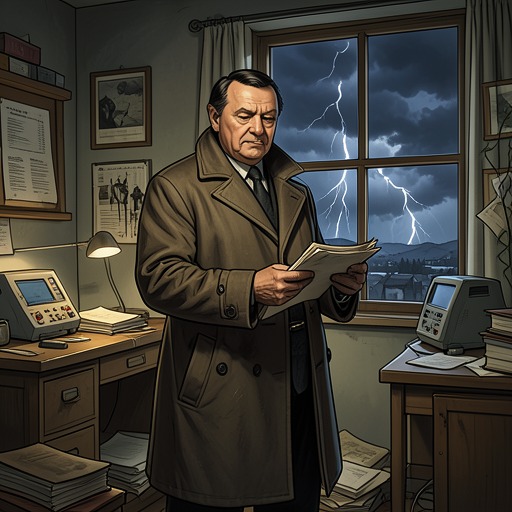
Ward Smith
Stranger in a Strange LandWard Smith is a physician, surgeon, and biologist whose place in the novel is defined less by a sustained on-page presence than by the consequences of the Envoy expedition and the disputed paternity of Valentine Michael Smith. Ward is Mary Jane Lyle Smith’s husband and Valentine’s legal father; after the expedition, the circumstances of Valentine’s birth make Ward’s family history a question of biological parentage, inheritance, and the law. The account eventually supplied by Ben Caxton also connects Ward to the expedition’s final tragedy.
Identity and Background
Ward is listed among the Envoy’s crew as a forty-five-year-old physician and surgeon, as well as a biologist. His professional identity matters again after the expedition: the crew’s records and the expedition’s medical circumstances become evidence in the investigation of Valentine’s parentage. In the novel’s brief references, Ward is both an identifiable member of a highly documented crew and a figure whose family role cannot be reduced to biological descent alone.
He was married to Mary Jane Lyle Smith, a twenty-six-year-old atomics engineer and electronics and power technician on the same expedition. The couple were one of four married pairs aboard the Envoy. Their marriage becomes central to the legal argument over Valentine’s status, even as evidence about his biological parentage points elsewhere.
The Envoy and Valentine’s Parentage
Ben Caxton explains to Jill Boardman that Valentine is the son of Mary Jane and Captain Michael Brant, not biologically Ward’s. The conclusion rests on the crew’s records and biological evidence: blood typing, Rh factor, and inherited traits including hair and eye color. Caxton describes the crew as exceptionally thoroughly measured and typed, making the recorded information unusually useful in establishing parentage. He also notes the exceptional intellectual ability of both biological parents: Brant had an IQ of 163, Mary Jane one of 170, and both were highly accomplished in their fields.
The discovery prompts Jill to object to the exposure of a family scandal involving people who are dead. Caxton’s response is that the question has practical consequences: Valentine’s inheritance depends on how his status is understood. Yet the novel complicates the apparent distinction between biological and legal fatherhood. Caxton explains that the laws applicable to Mary Jane and Brant recognize Valentine as legitimate, while the law of Ward’s home state treats a child born in wedlock as legitimate as well. In Caxton’s account, Valentine is therefore legally the legitimate child of three parents, despite having two biological parents.
That legal construction gives Ward a consequential place in Valentine’s identity. His marriage to Mary Jane supplies the marital basis for treating Valentine as Ward’s legitimate son under the law of Ward’s home state, while the separate legal rules governing Mary Jane and Brant also support legitimacy. The effect is not merely a technical label: Caxton concludes that Valentine can inherit from both fathers. Ward had family money, and Caxton identifies him as a medical man and scientist by choice; Brant, meanwhile, had invested much of his pilot’s salary and gambling winnings in Lunar Enterprises. The inheritance question thus rests on the interplay of family relationships, jurisdiction, and property.
The Expedition’s Final Tragedy
Caxton’s account of the Envoy’s last days is based on information he obtained from an informant, and he says he wishes he could inspect the ship’s recovered log. He doubts that the log will be released because, in his view, it contains a distressing story. What he has learned is that Ward performed a Caesarean delivery on Mary Jane and that she died during the operation. Caxton then reports that Ward killed Captain Brant and himself. The novel presents this as Caxton’s reported account rather than as a scene directly witnessed by the reader.
The revelation recasts Ward’s role in the expedition’s family history. Earlier, he appears in the crew list as a doctor and Mary Jane’s husband; later, his reported actions place him within the catastrophe that leaves Valentine alive but both biological parents and his legal father dead. Jill, herself a nurse, reacts with a shiver and claims professional immunity, which Caxton rejects. The exchange gives the revelation a human consequence without turning Ward’s death into a prolonged scene: the story reaches the reader through guarded disclosure and the distress it causes.
Narrative Role and Significance
Ward’s character is assembled retrospectively through evidence, legal explanation, and testimony. The crew manifest establishes his age and professions; the account of Valentine’s parentage identifies his marriage to Mary Jane; Caxton’s analysis reveals the legal consequences of that marriage; and the account of the expedition’s end connects Ward to the deaths that made the child an orphan. Each disclosure changes the meaning of the previous one. The man first named as Valentine’s father proves not to be his biological father, yet remains a father in the legal structure that secures Valentine’s inheritance.
The contrast between biological fact and legal status is central to Ward’s significance. The story neither treats family identity as a simple matter of genetics nor removes the practical force of law: Valentine’s descent from Mary Jane and Brant informs his heredity, while his birth within Ward’s marriage enables another legitimate claim. Ward’s limited presence is therefore structurally important. Through him, the novel links the lost Envoy crew to Valentine’s identity, the inheritance dispute, and the extraordinary consequences of survival.